Mid-Year Financial Checkup: Advice and Downloadable Couple’s Checklist

Updated: Aug 23

By July, the year feels like it is moving fast. Summer plans are in full swing, routines are looser, and money decisions often shift to autopilot. That is exactly why this moment matters.
The halfway point of the year is the perfect time for couples to pause and check in. Not to criticize or panic. Not to relive every purchase since January. Just to ask one simple question together:
How are you actually doing?
Think of this as your couple’s money midterm. A chance to review what you planned, see what changed, and make adjustments for the second half of the year while you still have time to influence the outcome.
What Did You Plan Earlier?
Most couples begin the year with good intentions. Save more. Pay down debt. Feel less stressed about money. Maybe you even set specific goals. I wrote about how to do this in the past post, Your New Year’s Resolution: Money Goals That Will Stick.
Sit down together and revisit what you hoped this year would look like financially. If you wrote goals down, great. If not, talk through what you remember discussing.
Evaluate the System, Not Each Other
This is where many couples get stuck. One partner feels behind. The other feels blamed. Conversations shut down before they even start.
So here is the rule: you are evaluating the system, not the people.
Think of your finances like a shared class you are both taking. A low grade does not mean someone failed as a person. It means the system needs work.
This is where a simple “Money Report Card” using my Annual Financial Checklist for Couples helps. Instead of arguing over individual decisions, look at categories together:
Savings progress
Debt reduction
Spending alignment with values
Organization and clarity
Communication around money
What you uncover tells you where to focus next.

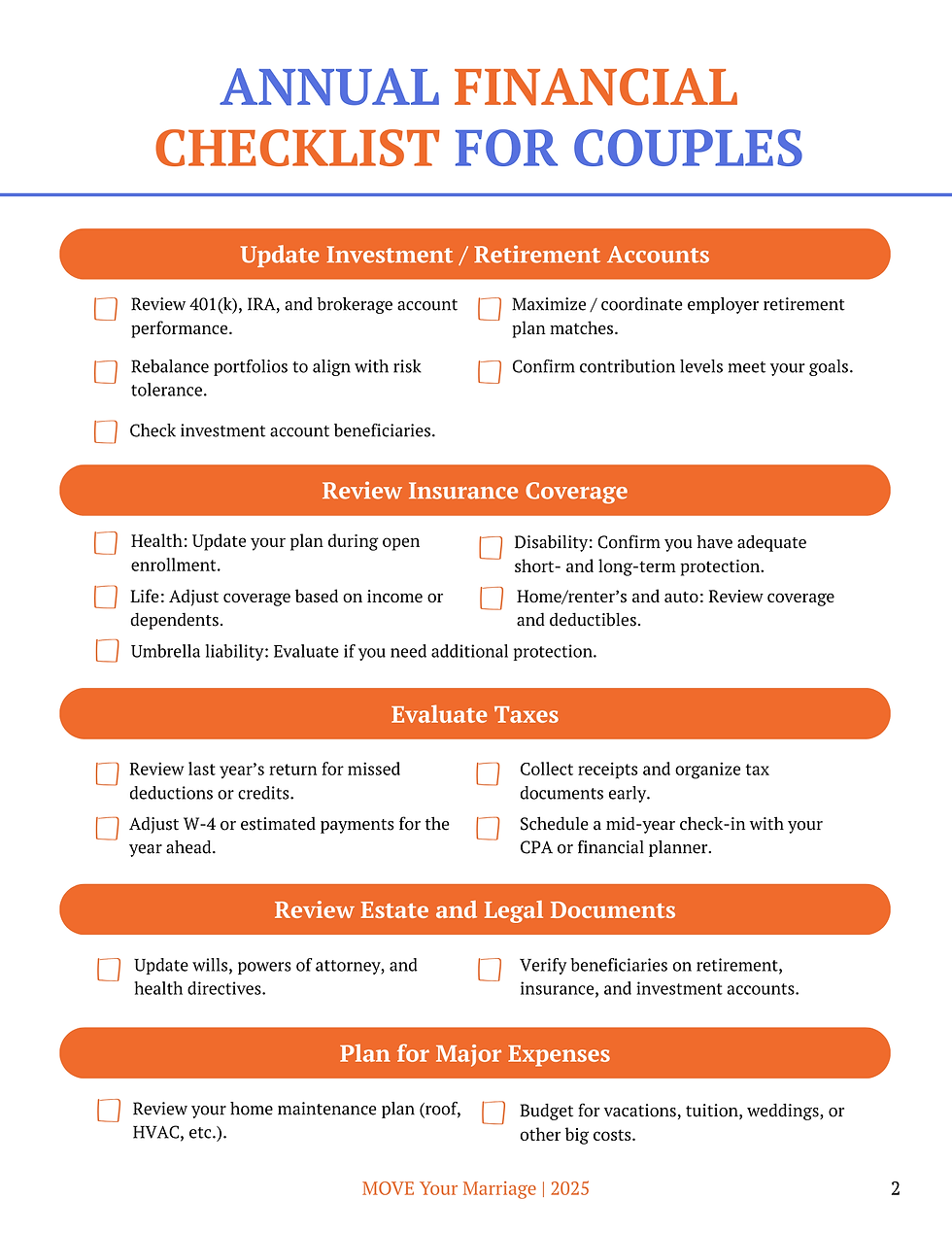
I created these checklists for our Move Your Marriage WeTreat. As I explained there, you do not need to complete this entire checklist in one month. Spread these topics across your monthly Money Dates, and you will stay financially aligned throughout the entire year.
Savings Checkup: Are You Still Paying Your Future Self?
Savings is often the first thing couples want to review, and for good reason. It is also where good intentions quietly erode.
Look at the progress you have made since January. Have you added to your emergency fund? Are sinking funds for travel, home repairs, or kids growing? Did retirement contributions stay consistent?
Then talk about income changes. If your household income increased this year, did your savings increase too?
This is where lifestyle creep shows up. When income rises and savings stays flat, money stress tends to linger even when things “should” feel easier. One of the most effective ways to reduce long-term stress is to intentionally increase savings when income rises, even by a small amount.
Related: Money Marriage U Budget.
Debt and Cash Flow: Is the Plan Still Working?
Mid-year is also a smart time to review debt and cash flow. Balances change. Interest rates change. Priorities change.
Look at your outstanding balances, minimum payments versus what you are actually paying, and whether your current plan still makes sense.
For some couples, this might mean accelerating debt payoff in the second half of the year. For others, it might mean temporarily easing pressure to rebuild savings or cash flow stability.
For specific direction and insight into selecting the best debt repayment plan for you, read my post, How to Reduce Credit Card Debt in Your Marriage. You will find details on four different approaches that you can apply to any type of debt.

The Most Overlooked Grade: How Are We Talking About Money?
Here is the part most spreadsheets miss. How does it feel to talk about money together? Are your Money Dates productive?
Strong financial systems reduce conflict by reducing ambiguity. Clear ownership, shared visibility, and regular check-ins matter just as much as dollars and percentages.
If money talks and you always feel tense, that is not a character flaw. It signals that the system needs support.
Professional Support

I support couples who want to better manage money and the home as a team. I am also available for group coaching events.
I'm the only Certified Financial Therapist™, Accredited Financial Counselor®, and Fair Play Facilitator®, empowering high-achieving couples with systems to manage money and the home as a team — drawn from decades of national leadership and lived experience.
Click here for more details about how and when I can support you.
Modern Husbands Podcast
Winning ideas from experts to manage money and the home as a team. 2023 Plutus Award Finalist: Best Couples or Family Content
🔔 Click here to listen and subscribe to the Modern Husbands Podcast on Apple.
🔔 Click here to listen and subscribe to the Modern Husbands Podcast on Spotify.
Modern Husbands Bimonthly Newsletter
Winning ideas to manage money and the home. Click here to subscribe.


