A Modern Husband’s Take on: Notes on Being a Man


What does a masculine man look like to you? How does he show up in his relationships, for his partner, his kids, his friends?
Over the past decade, what it means to be masculine has been held hostage by folks from all walks of life, claiming their own vision as truth and demonized in some ways. Some have red pilled countless men, weaponizing what it means to be a man, contributing to the spiraling of men into suicide attempts that are 4x the rate as women.
Others find problems human beings face or create, label them with a derogatory term, and then bookend "man" or “masculinity” to it.
Slicing and dicing human beings by gender and then using catch-all labels to assign blame puts people on their heels, leaving some men to search for answers on social media, where the algorithms lead them toward a dark path of hate and divide.
I read Notes on Being a Man because I hold Professor Galloway in such high regard. I'm a regular listener to his podcasts, Raging Moderates and The Prof G Pod, and subscribe to his newsletter, No Mercy / No Malice. His political proclivities, in particular his social views and insights on the macroeconomic and financial-market crossroads, speak to me, so I assumed his book would, too. And I was right.
I'm being presumptuous here, but much of my appreciation for Galloway's Notes on Being a Man stems from my belief that he wrote it as a memoir for his boys; a legacy of written words, disguised as a book entitled to ride the wave of conversations about masculinity. If I'm right, that makes the book all the better.
Many of the memories he shared growing up was when his mother was single, scraping by and sacrificing for him. His deep love and appreciation for his mother clearly shaped who he is and his view of what it means to be a man.
From the outset, he shares that men should be providers, protectors, and procreators: terms that anchor ideas of outdated norms without the explanations his book provides—nuance matters, and so does his upbringing.
Galloway’s definition of provider, protector, and procreator connected deeply with me, so that’s where I’ll start.
Men as Providers
The hard truth is that 71 percent of women still believe a good husband or partner must be financially able to support his family. When men were asked the same question about women, only 25 percent said the same, which explains husband guilt.
Research on online dating makes the pressure even clearer. Women don’t just prefer higher-income men. They specifically prefer men who earn more than they do. Research found that men with the highest incomes received 10 times as many profile visits as men with the lowest incomes.
A convenient truth would be that none of this is true. But it is. Most women still aspire to egalitarianism in the home and desire men who bring home more of the bacon.
While men are expected to be capable financial providers for their families, the mantra for women more often resembles the capability to provide for themselves. That’s far less pressure. We’ve all heard it before, “A man is not a financial plan.”
I see the difference in financial expectations as the consequence of women being oppressed for generations, women trapped in marriages because they couldn’t provide for themselves.
The origin stories of money and gender are deeply rooted in our conscience and subconscious beliefs.
Some Providers Step Aside
Professor Galloway points out that being a provider sometimes means stepping aside in your career so your wife can crush it in hers. Do all you can at home to support her when her career ambitions and income potential outweigh your own.
Damn, it felt great when I heard him say this. It was masculating – confirmation that what I did and the mission of Modern Husbands is the right thing to do, and it also signals strength.
“Stepping aside” isn’t easy for some men, as they experience distress and anxiety when they contribute less than 60% of the household income. Yes, men need to work through this, but their partners need to own part of that responsibility as well.
Basic math tells you that this will be the case in a lot of future marriages, as women are now outpacing men as college graduates at every degree level. And before the motherhood penalty strikes, the gender pay gap has nearly disappeared.
Men as Protectors
Lift weights. Get bigger. Break up fights. Stand up for the marginalized.
Professor Galloway’s succinct message to men spoke to me. I’m not an amateur MMA fighter, but I am 6’3 255. I lift and hit the punching bag. I took on the responsibility of managing our home security system. And yes, I have been trained to use and do own firearms that are secured in our home.
He’s not saying that women can’t be protectors. I wouldn’t say that either. Ronda Rousey would whoop my ass. And have you met a “mama bear?”
Politics and Religion
Galloway points out that some have weaponized politics and religion to attack the marginalized, and it’s the responsibility of strong men to defend them. He specifically brought up transgender people and immigrants.
I couldn’t agree more. Allow me to elaborate.
Just as Hitler brutalized the transgender community early in his reign, so has Trump. His first executive order removed wide-ranging federal protections for transgender people. Trump removed federal protections from being bullied in school and job discrimination stemming from gender identity. Trump also stole the identity of transgender people in passport issuance policy reversal.
The latest attack is through a CFPB proposed rule change that would allow financial institutions to deny access to banking and lending services based on gender.
Trump is doing all he can to erase the existence of transgender identity, refusing to accept them as human beings.
Without warrants, immigrants are being disappeared by masked men. The number of non-criminal detainees arrested by ICE has surged by 2,000% under Trump, while immigrant children sent to detention centers are at a record high.
The transgender community and immigrants are not safe in the United States, and it’s up to real men to stand up and protect them from the wicked who weaponize the Bible and their politics to feed their appetite of hate and cowardice.
Men as Procreators
Choosing to bring a child into the world means fully accepting the lifelong responsibility of raising, supporting, and protecting that child. The time you can give to love them, the financial resources needed to empower them, and the strength it takes for a couple to weather the toughest storms together.
Absent fathers are strongly associated with serious challenges for boys and men, including greater risk of poverty, lower educational attainment, higher rates of substance use, and increased involvement with the justice system.
71% of high school dropouts are fatherless.
85% of youth in prison have an absent father.
90% of runaways are fatherless children.
63% of teen suicides are fatherless kids.
Today, roughly one in four children in the United States grows up without a father in the home.
Professor Galloway leans heavily in this area to what Richard Reeves shares in Of Boys and Men. As he should. The message is clear to men – when you fail your kids you are failing as a man.
5 More Topics Galloway Addresses With Excellence
Beyond his core framework of provider, protector, and procreator, Galloway widens the lens even further, tackling the everyday disciplines that quietly determine the quality of a man’s life.
These next five themes move from identity to daily practice from how we give, to whom we lean on, to how we love, work, and care for our bodies. Together, they form a blueprint for a life that is not just successful on paper, but meaningful in reality.
1. Surplus Value
Give back more than you take. In your relationships. With your friendships. For the world.
That’s surplus value.
Pour back into those who poured into you. We remember when we can’t as motivation to pay it forward even more in the future.
The simplicity of the concept is easy to stick with throughout our days. Our partner worked a long day outside the home, so when they get home, it’s a place of peace. Kids can keep their negative emotions bottled up at school because they trust you can handle the explosion when they get home. And you always take it.
Men should give back through our time, treasures, and talents. Be a mentor. Volunteer as a coach. Give to your favorite charities.
2. Friendships
Galloway was quick to point out the findings of the world’s longest-standing study on happiness run out of Harvard:
“Close relationships and social connections are crucial for our well-being as we age.”
Our childhood friendships also shape who we are. Professor Galloway generously credits his closest childhood friends as among the most influential factors in his success. I feel this, and if you’re our age, you might too.
If you’re also from Generation X, your childhood is probably full of memories of being outside, doing things we would never want recorded, at a time when the government had to run TV commercials to remind parents they had kids and to make sure they came home at night.
Such freedom built resiliency, creativity, courage, and toughness. Traits we developed with our friends, sometimes because of our friends.
3. Relationships
“Who you marry is meaningful — who you have kids with is profound.” - Professor Galloway
Profound — that is great intensity, is right. Kids make life harder. Maybe you’re accustomed to Pollyanna posts on social media. Who is going to argue that kids bring joy to the world (but leave out the asterisks)?
Of course, our kids can bring us joy. They can also bring heartache, pain, stress, and anxiety. Romanticizing parenting is unfair to those of us in the real world.
But kids also produce many of our most incredible memories, and an unconditional love that cannot be replicated. Galloway gets it – and the experiences shared with his own kids reflect that.
Marriage
“Great relationships include people who share passions, values, and money.” - Galloway
That’s a mic drop of an observation. Spending hours doing what you love, with who you love, and spending money on your shared values is the trifecta for easier daily living.
Money often muddies the water, mainly because our relationship with money stems from our own childhood experiences. It isn’t very easy. It takes work. I see this as a professional who helps couples manage money as a team.
Money is also a leading indicator of divorce – it permeates every aspect of our lives. When men don’t provide financially, it leads to resentment and contempt. The pressure is real, absent intentional intervention from a loving wife who sees earning income as a team sport, and a man who sees the work in our homes as the same.
I respect and can appreciate all types of relationships, but we can’t hide from the fact that, for the most part, people in happy marriages are happier than all others. They are also wealthier. Much wealthier.
Invest in your relationship. Don’t keep score. Focuses on experiences.
Easier said than done, that is, without intentionality. Early peak happiness occurs on our wedding day. If you don’t believe me, ask an engaged couple. They have it aaaaaall figured out. But the real work begins after the wedding to prevent the dip in happiness.
Invest In Your Relationship
Compounding interest, widely referred to as Einstein’s 8th wonder of the world, drove my own desire to save and invest as much as I could when we were young. Doing so has paid off, a timely example as our kids matriculate to college is what we did with our first property, but that’s not what Galloway was referring to.
Investing in your relationship means putting in the hard work to move forward together. I never would’ve considered attending our own Move Your Marriage when I had young children, a short-sighted and unwise flaw of frugality, and a narrow view of investment. And that’s exactly the type of investment Galloway was referring to – an investment in your relationship.
Don’t Keep Score
Keeping score leads to resentment. Resentment leads to contempt. Contempt is the most destructive negative behavior in relationships, according to Dr. John Gottman, who, after four decades of research, found it to be the number one predictor of divorce.
Focus on Experiences
Galloway highlights the importance of spending money on experiences, and the examples he shared with his boys connected with me. As an avid soccer fan myself, in particular Arsenal and Barcelona, I particularly admired Professor Galloway’s stories of taking his boys to those games, despite his not being much of a fan.
A plurality of research shows that experiences make people happier than possessions. New cars, furniture, bigger houses – they don’t pay much of a happiness dividend. Hell, studies show they can have the opposite effect when consumers see their previous purchases on sale for a fraction of the price later.
4. Trade-offs
“There is no such thing as balance — only trade-offs.” - Professor Galloway
The time trade-off we make between work and family is a zero-sum choice. What’s the calculus for figuring out the exact amount of time we can afford to spend not working outside of the time, not being a financial provider, so that we can use that time with our family?
As Galloway points out, the time you spend in your home has an inverse relationship with career success.
5. Health
Galloway stresses that we should take care of our bodies. Lift weights. Get bigger. Eat healthy. Looking as good as we can, or at least trying, is an integral part of being a man. It’s common sense, but not said enough, that our spouses appreciate it too.
When we look good, we feel good, which is an essential part of our overall health. One of my favorite lessons from his book is the acronym he relies on when he starts to feel down.
SCAFAN
Sweat
Clean eating and a clean home
Abstinence (no drugs or alcohol)
Family/friends
Affection
Nature (my addition)
Go back to basics when you feel bad. Work out. Live in a clean home and only put food in your body that serves as fuel, not comfort. Stay far away from drugs and alcohol. Lean into friends and family. Give and take the affection craved from your spouse.
I added the N for nature. Studies show that quality time spent in nature cleanses the mind.
Wrapping It Up
In the end, Notes on Being a Man is not a manifesto for dominance, nor a nostalgic plea for the past. It is a call to responsibility, humility, service, and strength in its most grounded form. To provide, protect, and procreate is not about control. It is about showing up with consistency, courage, and care in a world that desperately needs steady men.
If masculinity is going to evolve, it will not be through outrage or algorithms, but through men who choose to invest in their families, their communities, their bodies, and their character. That is the kind of man worth becoming.
Professional Support
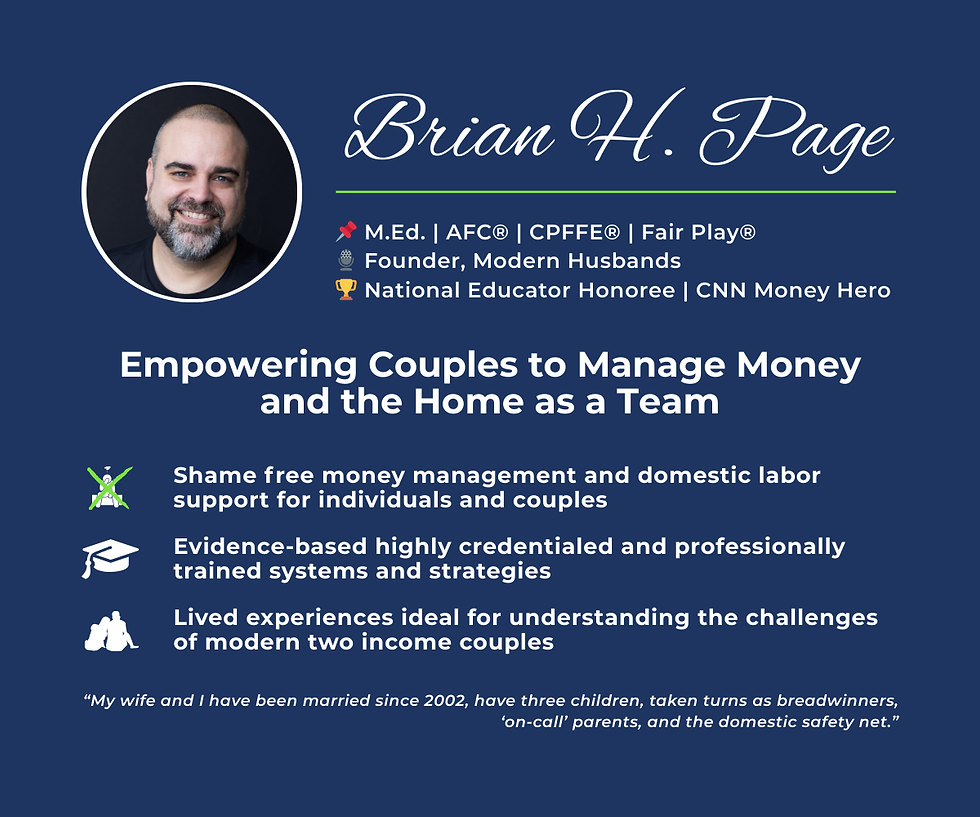
I support couples who want to better manage money or the home as a team in their relationship. I am also available for group coaching events.
I'm the only Accredited Financial Counselor® and Fair Play Facilitator®, empowering high-achieving couples with systems to manage money and the home as a team — drawn from decades of national leadership and lived experience.
Click here to schedule a free 15 minute exploratory call.
For more ideas to manage money and the home as a team in your marriage, click here to take advantage of our free preview of our Marriage Toolkit.