Female Breadwinners: Understanding the Dynamics from the Perspective of Men

When a woman becomes the primary earner, it doesn’t just change a family’s budget; it reshapes long-held ideas about identity, love, and partnership. Drawing from Melissa Hogenboom’s Breadwinners, we can see that this shift often introduces new emotional and social challenges for men who were raised to see providing as central to masculinity.

7 Complexities to Female Breadwinning Relationships
From navigating subtle forms of stigma to redefining equality at home, these men and their partners find themselves on the front lines of changing gender norms. I’ve also experienced some of these challenges myself. My wife is now the breadwinner in our relationship.
Below are seven key complexities men commonly face when married to a female breadwinner, and what these dynamics reveal about how far we’ve come and how much further we still need to go.
1. Threat to Traditional Masculine Identity
Men raised with the expectation of being providers often experience a blow to their sense of self when their wives earn more. Breadwinning remains deeply tied to masculine identity, so losing or sharing that role can lead to feelings of inadequacy or emasculation.
2. Lower Relationship Satisfaction When Roles Reverse
Studies cited in the book reveal that relationship satisfaction tends to decline when women are the main earners, especially when the shift happens involuntarily (for example, because the man lost his job). Men reported lower well-being when their partner worked and they did not—sometimes even preferring both to be unemployed rather than see their partner provide alone.
3. Social Isolation and Lack of Peer Support
Stay-at-home or lower-earning men often feel isolated from social groups like baby classes or parent networks. Many describe being the only man in a room of mothers, feeling excluded or judged. This lack of community reinforces their sense of “otherness” in a still gendered parenting culture.
4. Judgment and Stigma from Others
Couples who reverse gender norms often face subtle or overt judgment from relatives, friends, and even strangers. Men who are not working outside the home may be viewed as lazy or unambitious. At the same time, their partners are sometimes criticized for being “too driven” or “unfeminine,” which strains both partners emotionally.
5. Unequal Division of Domestic Labor Persists
Even in households where women earn more, men rarely take on an equal share of household chores or “mental load.” Many female breadwinners still shoulder the majority of domestic organization and invisible labor, creating tension and resentment that can undermine the relationship.
6. Financial Power Imbalance Reversal Can Be Uncomfortable
While men historically have used financial control to reduce household duties, when women become breadwinners, both partners may struggle to renegotiate financial and emotional boundaries. Men may feel uncomfortable accepting financial dependence, while women may overcompensate by taking on extra home labor to “soften” the role reversal.
7. Cultural Lag in Accepting New Norms
Although younger generations show less attachment to the “male provider” ideal, cultural and institutional norms still reinforce it. This lag—between evolving personal beliefs and persistent societal expectations—creates internal conflict and external pressure for men dealing with these reversed roles.
A Conversation with Melissa Hogenboom
We welcomed Melissa Hogenboom, an award-winning journalist and editor at the BBC who is the author of Breadwinners, as a guest on the Modern Husbands Podcast where we delve into the intricate dynamics of gender roles and economic anxiety.
We explore the challenges faced by female breadwinners, the psychological impact of economic instability on men, and the evolving expectations of masculinity. Through insightful discussions, we uncover how societal norms and financial pressures shape relationships and individual well-being.
Listen to the episode to gain a deeper understanding of these pressing issues and discover actionable steps to foster equality and resilience in modern partnerships.
Wrapping it Up
Hogenboom’s research shows that when women out-earn their husbands, the resulting relationship dynamics are complex. Men often grapple with a loss of identity, external judgment, and a lack of community support.
Yet, as cultural norms evolve and both partners redefine power and care, these couples also have the potential to model more equitable and emotionally intelligent partnerships.
Professional Support
Professional Support
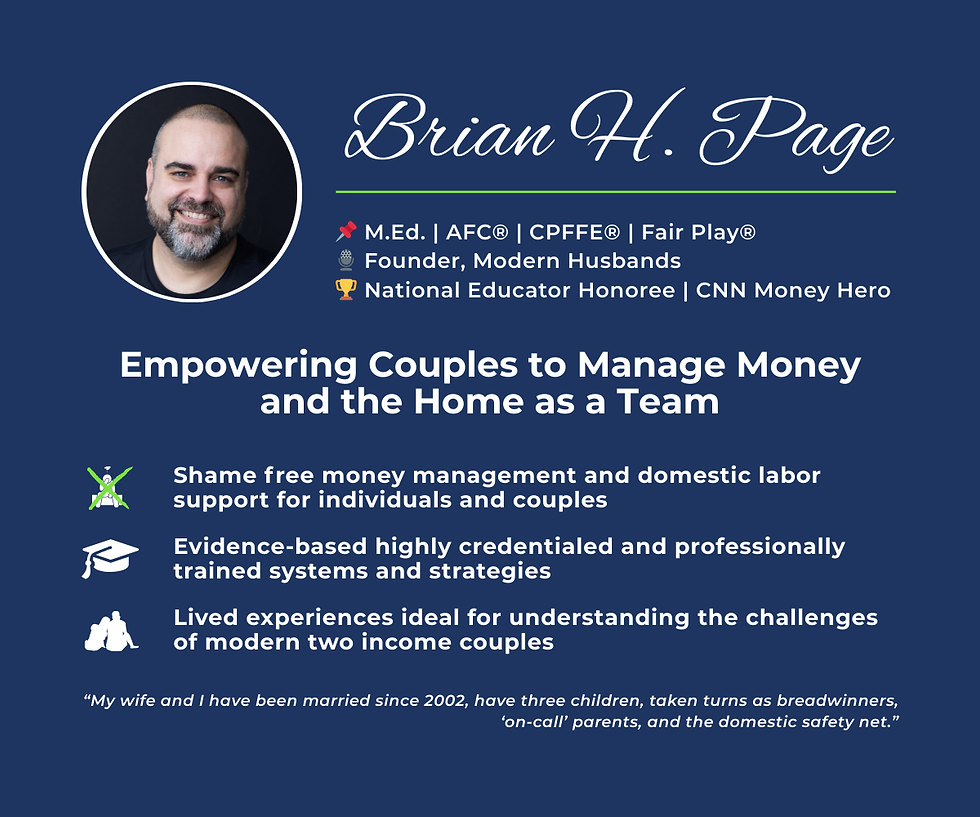
I support couples who want to better manage money or the home as a team in their relationship. I am also available for group coaching events.
I'm the only Certified Financial Therapist™, Accredited Financial Counselor® and Fair Play Facilitator®, empowering high-achieving couples with systems to manage money and the home as a team — drawn from decades of national leadership and lived experience.
Click here for more details about how and when I can support you.
Modern Husbands Podcast
Winning ideas from experts to manage money and the home as a team. 2023 Plutus Award Finalist: Best Couples or Family Content
🔔 Click here to listen and subscribe to the Modern Husbands Podcast on Apple.
🔔 Click here to listen and subscribe to the Modern Husbands Podcast on Spotify.
Modern Husbands Bimonthly Newsletter
Winning ideas to manage money and the home as a team delivered to your inbox every two weeks. Click here to subscribe.

