Sharing the Mental Load: What Couples Need to Know About Cognitive Labor

When most couples argue about housework, the conversation usually focuses on what needs to get done: laundry, dinner, kids’ activities. But beneath the visible chores lies a quieter, invisible force driving family life: cognitive labor.
Also known as the “mental load,” cognitive labor refers to the behind-the-scenes work of anticipating needs, identifying options, making decisions, and monitoring outcomes.
Essentially, it is the thinking required to keep a household running. If you’ve ever felt overwhelmed by planning dinner, coordinating childcare, or juggling your kid’s schedule without missing a beat, you’ve felt its weight.
I recently spoke with Dr. Allison Daminger, sociologist and author of What's on Her Mind: The Mental Workload of Family Life, who spent years researching how couples divide this often-overlooked form of labor. What she found is something every dual-career couple needs to hear.
The Mental Load in Everyday Life
Cognitive labor isn't about spreadsheets or day planners. It’s deeply human and often invisible. As Dr. Daminger explained, “Everybody’s got to eat.” Planning meals means scanning the pantry, identifying recipes, checking for allergies or preferences, deciding what to make, and sometimes texting your spouse to remind them to grab dinner on the way home. It all happens in a split second in your head, and it repeats every single day.
Fifteen years ago, I was working 80-hour weeks, and even though I loved to cook, I didn’t fully appreciate how much planning my wife was doing to feed our family. I took for granted how much of her brain space was devoted to running the home. Now that our roles have shifted and I’ve stepped into the lead domestic role, I see it and feel it clearly.
The Superhuman and the Bumbler
In her research, Dr. Daminger found that even couples who value equality tend to fall into an imbalanced pattern. Most of the women she interviewed described doing “more or much more” of the cognitive labor. What surprised her wasn’t the imbalance. It was how couples explained it.
Instead of pointing to inequality, they chalked it up to personality. “She’s Type A,” or “He’s just more laid back.” Dr. Daminger calls these archetypes the Superhuman and the Bumbler. And in most cases, the woman is the Superhuman.
But here’s the problem: this explanation reinforces the idea that domestic competence is innate when it’s actually a set of skills like foresight, memory, and task management that anyone can learn.
Why It Persists, Even With Good Intentions
So why do these patterns stick, even among progressive couples? Dr. Daminger points to gender socialization. From a young age, girls are praised for being conscientious and are often encouraged to notice and respond to others’ needs. Boys, meanwhile, are rewarded for independence and ambition.
Add in social networks (many parenting resources and groups are mom-centric), and women get more reps practicing cognitive labor before they even have kids. Meanwhile, men may enter parenthood without the same exposure or encouragement to build those skills.
As Nobel Prize-winning economist Claudia Goldin has shown, women are often the ones who fill in at home when their male partners are consumed by “greedy work,” jobs that demand long hours and leave little energy for anything else. Dr. Daminger's findings echoed this: even high-earning, long-working women still did more cognitive labor than their husbands.
Lessons from Same-Sex Couples
One of the most illuminating parts of our conversation was what Dr. Daminger learned from same-sex couples. While inequality still existed, it was less pronounced and less distressing. Why? Three key reasons:
No predefined roles. They chose responsibilities based on strengths, not gender.
Open communication. They talked regularly about who was doing what.
Belief in change. They assumed they could adapt if something wasn’t working.
This flexibility and teamwork mindset is a model for all couples, regardless of gender.
How to Rebalance the Mental Load
Dr. Daminger offered a clear, step-by-step roadmap for couples ready to move toward a more equitable division of cognitive labor:
Get aligned
Have a calm conversation about your ideal division of labor. It may not be 50/50, and that’s okay. What matters is that it’s intentional.
Audit your current state
Keep a “decision diary” for a week to track who is doing the behind-the-scenes thinking.
Start small
Choose a low-stakes area (for example, dinner planning or car maintenance) for one partner to take over completely from conception to planning to execution.
Expect growing pains
Rebalancing cognitive labor isn’t seamless. Let your partner fail and learn. Agree on minimum standards, but give each other room to do things differently.
As a Fair Play facilitator, I use the CPE model: Conception, Planning, and Execution. If you don’t own all three stages, you’re not truly carrying the task.
Seek Professional Support
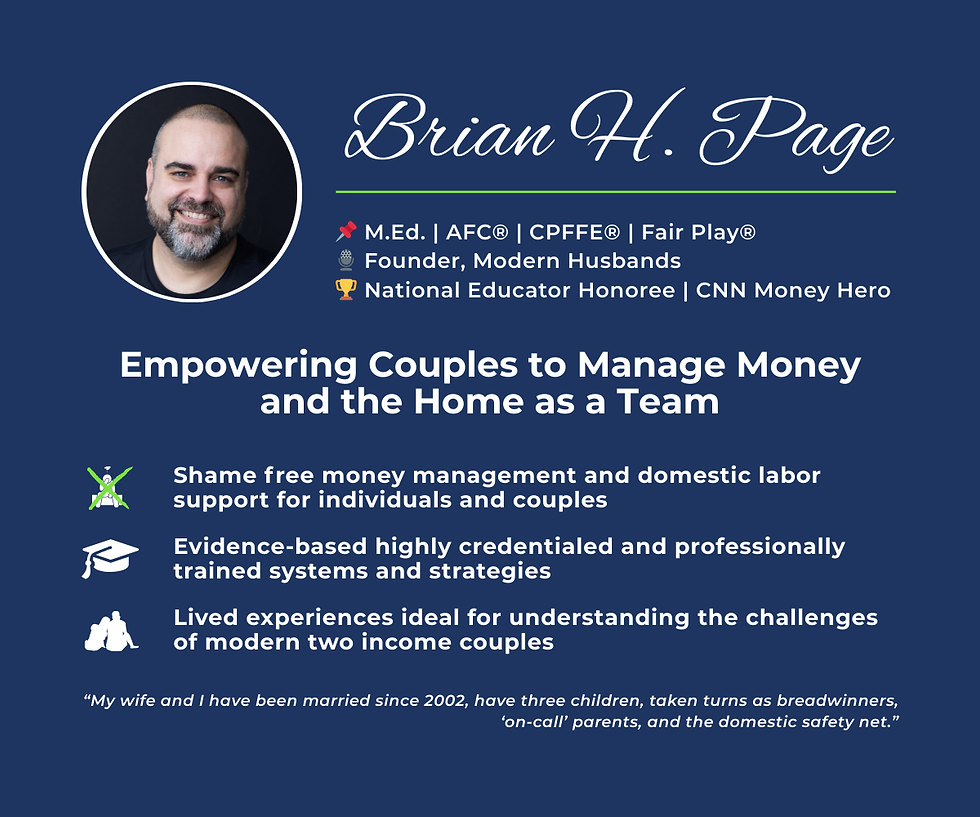
I support couples who want to better manage money or the home as a team in their relationship.
I'm a Fair Play Facilitator® (and an Accredited Financial Counselor®) empowering high-achieving couples with systems to manage money and the home as a team — drawn from decades of national leadership and lived experience.
Contact me to set up a free 15 minute exploratory call.
How Men Can Show Up Better
Most of the men Dr. Daminger interviewed wanted to help but didn’t know how. Some felt they “weren’t good at that stuff.” But here’s the truth: many already use the same skills in their professional lives like time management, project tracking, and decision-making.
The challenge isn’t ability. It’s transference. If you’re organized at work, you can be organized at home. Whether it’s using a shared calendar, owning school registration deadlines, or managing weekly grocery logistics, the tools already exist in your toolkit.
Apps like Persist can help. My wife and I used it to visually see how cognitive labor was distributed in our home. That clarity opened the door to more productive and empathetic conversations.
The Cost of Inaction
Unequal mental labor doesn’t just cause tension. It shapes lives. Dr. Daminger shared stories of women scaling back careers or switching firms, not because they wanted to, but because they couldn’t sustain both a heavy home load and ambitious professional goals. The option to ask their partner to take the lead never even crossed their mind.
That’s a loss, not just for them, but for their families and for a society that benefits when everyone gets to reach their potential.
The Conversation That Changes Everything
If you take one thing away from this post, let it be this: talk about it.
Ask your partner, “How do you think we’re doing when it comes to the mental load?” You might be surprised by the answer. Start the conversation before conflict forces it, and revisit it often.
This isn’t about perfection. It’s about progress, partnership, and designing a home life that lets both people thrive.
Our Podcast Episode with Dr. Daminger
Show Notes
01:00 Introduction
01:55 Let’s start with the basics. What exactly is “cognitive labor,” and how is it different from other types of household labor?
05:02 You break down cognitive labor into four tasks: anticipating, identifying, deciding, and monitoring. Can you walk us through what those look like in everyday family life?
16:28 One of your findings is that even in households that believe in equality, women tend to carry more of the mental load. Why is that, and how does it persist even with good intentions?
25:36 How do early childhood experiences shape the way men and women learn (or don’t learn) to do cognitive labor?
28:44 Your research includes same-gender couples. What lessons can different-gender couples learn from how cognitive labor is handled in those relationships?
32:11 Let’s talk about solutions. What can couples do if they want to move toward a more equitable distribution of cognitive labor? Where should they start?
38:14 You write that many men want to help but feel unsure about how to jump in. What advice do you have for those men to begin showing up better?
43:21 In the book, you describe how unequal cognitive labor can impact a woman’s identity, stress levels, and even career. Can you share a story or example that really stuck with you?
45:32 Where can our listeners learn more about you and purchase your book?
46:03 What is one piece of simple and actionable advice you want to leave our listeners with?


